Method
Bifrost® uses established bibliometric metrics and methods. This page is grouped by level of analysis: first metrics that describe individual publications, then metrics that describe journals, and finally analytical methods that operate over collections of publications. Each section has a short description and a reference to the original source or primary documentation.
Publication level
FWCI (Field-Weighted Citation Impact)
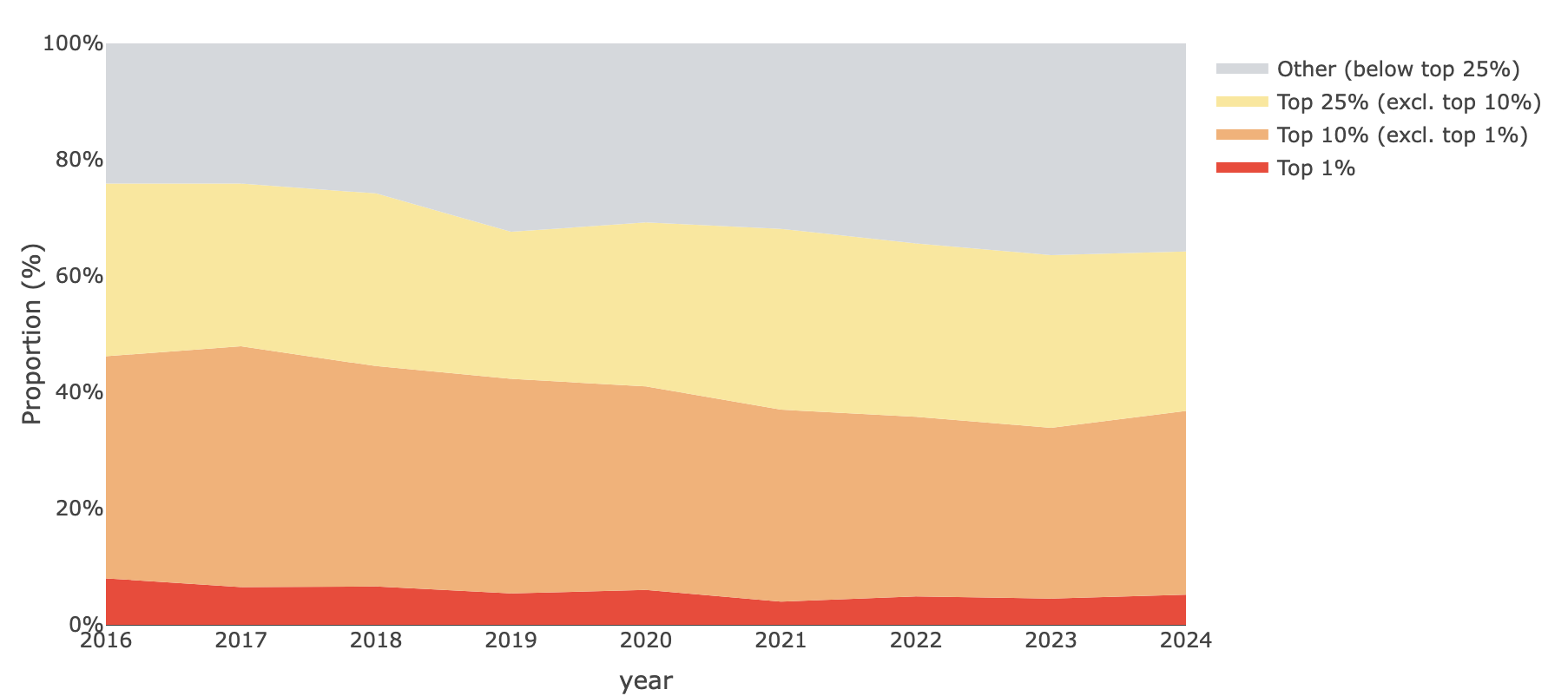
Citations normalised against the subject area to which the publication belongs. An FWCI of 1.0 means the publication has been cited as much as the average in its field; 2.0 means twice as much. FWCI is used because raw citation counts are not comparable across fields: medicine is cited considerably more than the humanities. In Bifrost, FWCI is taken from OpenAlex data.
Note: FWCI for recently published works (0–2 years) is preliminary because the citation window has not yet closed.
Scope: FWCI requires the publication to have a DOI that matches OpenAlex. Reports based solely on SwePub or DiVA (without OpenAlex enrichment) lack FWCI.
Read more: The OpenAlex documentation on FWCI. For a theoretical discussion of field-normalised indicators, see Bornmann & Marx (2018), Critical rationalism and the search for standard (field-normalized) indicators in bibliometrics. Sample size is discussed in Rogers, Szomszor & Adams (2020), Sample size in bibliometric analysis.
Open access status
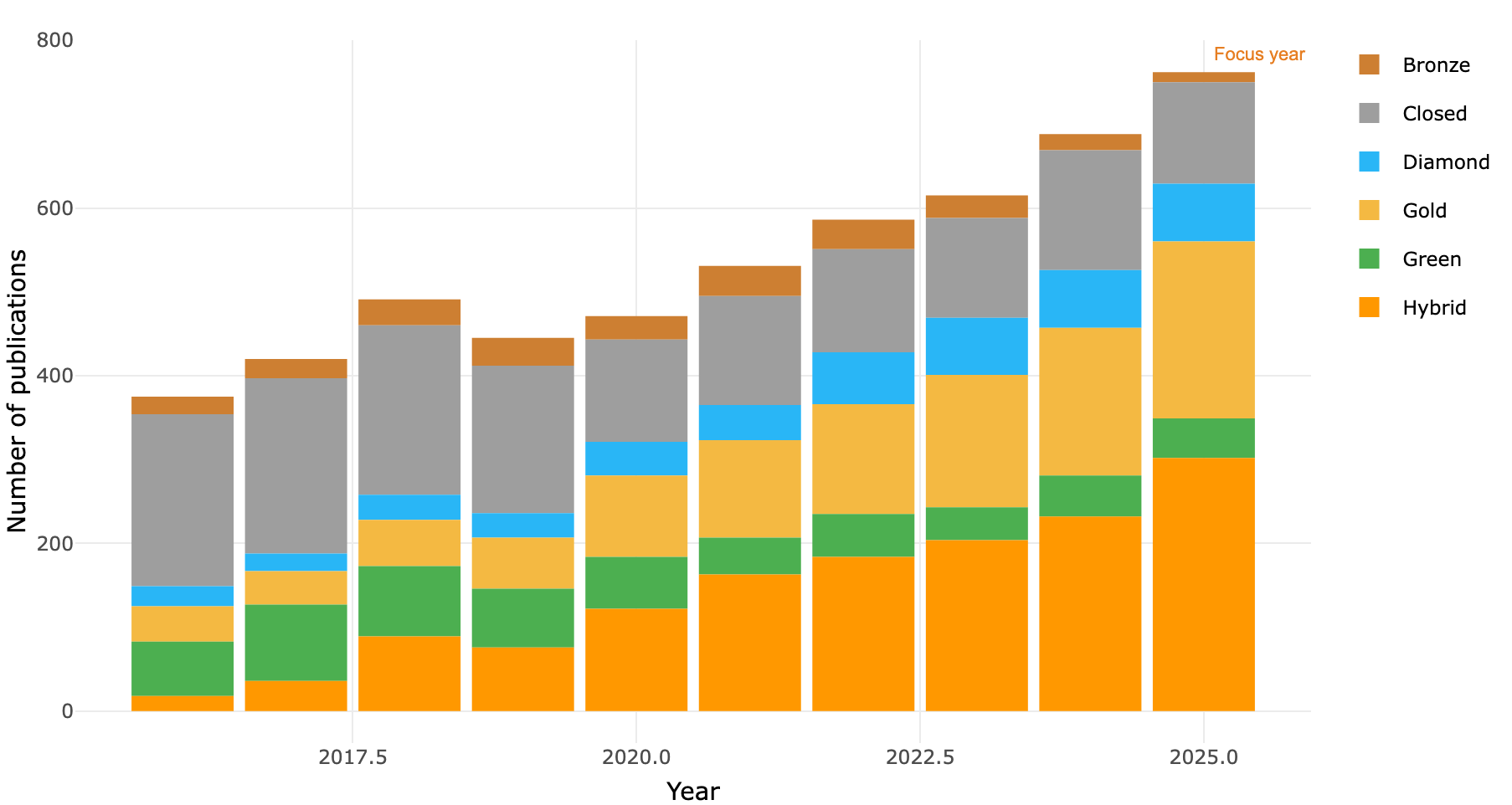
Bifrost classifies publications according to established OA categories: gold (published in an OA journal; may include diamond OA where no APC is charged), green (postprint in a repository), hybrid (OA in a subscription journal for a fee), bronze (free to read without an OA licence) and closed. The sources complement each other: OpenAlex has broad coverage (OA status via Unpaywall), while SwePub has curated Swedish data.
In case of conflict: OA classification from different sources may differ for the same publication. Bifrost keeps the OA status from the primary source (e.g. SwePub) where available, and uses OpenAlex/Unpaywall as a supplementary source for publications that lack an OA value in the primary source.
Journal level
NPI level (Norwegian publication indicator)
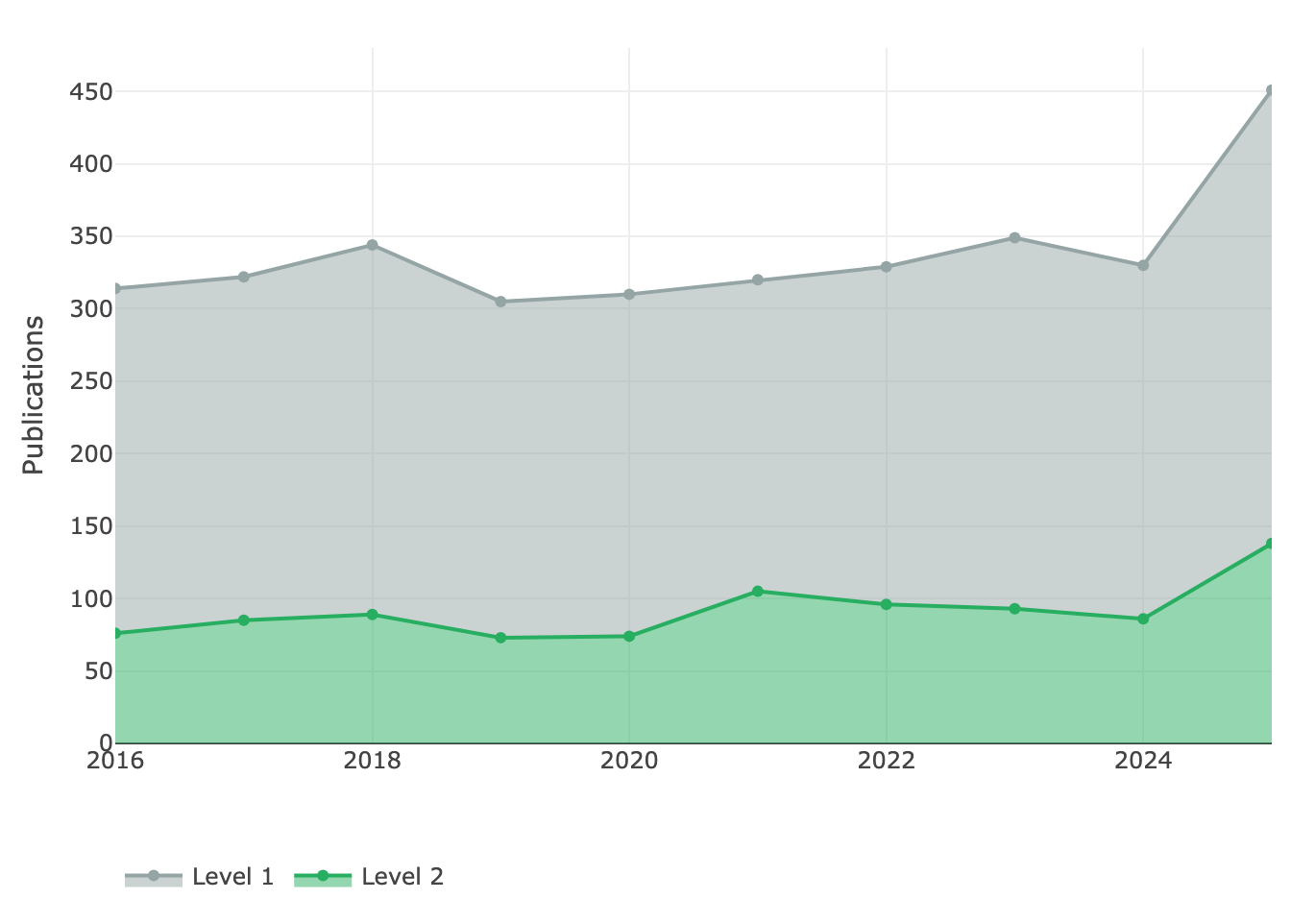
Journals and publishers are classified at level 1 (an established scholarly channel) or level 2 (leading in its field). It is used as a quality marker in Swedish and Norwegian resource allocation. Bifrost looks up each journal's ISSN against Kanalregisteret, which is maintained by HK-dir (the Norwegian Directorate for Higher Education and Skills). Kanalregisteret is updated continuously; Bifrost retrieves current data at report generation (cached for up to 30 days).
Read more: HK-dir (2026), Norsk publiseringsindikator (NPI). For a critical discussion of the system, see Schneider (2016), The new Norwegian incentive system for publication, and Haugen & Sandnes (2016), From bad to worse.
SJR quartile (SCImago Journal Rank)
Journals are ranked within their subject area into four quartiles (Q1–Q4) based on the SJR value, where Q1 is the top 25% by ranking. SJR weights citations by the prestige of the citing journal, which counteracts inflation through self-citation. Updated annually.
Read more: SCImago Journal & Country Rank (primary source and annual publication).
Analytical methods
CAGR (Compound Annual Growth Rate)
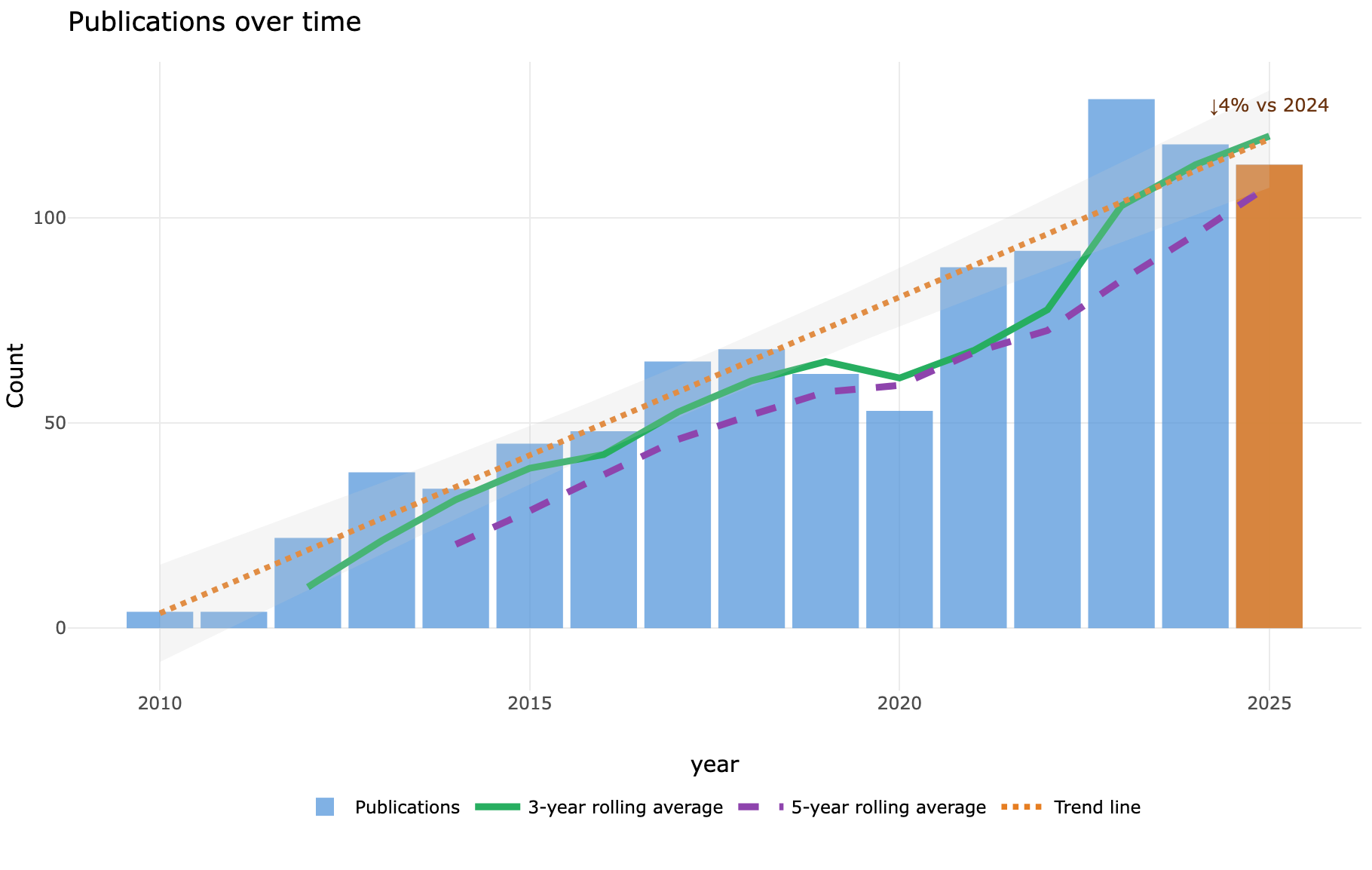
The geometric mean of the annual growth rate over a period of time. Bifrost uses it to describe how the number of publications within a subject has changed over time; it is more robust than linear trend lines when volumes vary.
It is calculated by the formula CAGR = (end value / start value)^(1 / (n−1)) − 1, where n is the number of years in the period. A CAGR of 0.10 means 10% average annual growth.
Burst detection (Kleinberg's algorithm)
Identifies keywords or subjects that suddenly increase sharply in frequency. It is useful for detecting emerging research foci before they become visible in long-term trends. The algorithm looks for periods in which a keyword occurs unusually densely compared with the background level and marks these as bursts.
Read more: Kleinberg, J. (2002), Bursty and Hierarchical Structure in Streams, in Proceedings of the 8th ACM SIGKDD International Conference on Knowledge Discovery and Data Mining.
Co-authorship networks
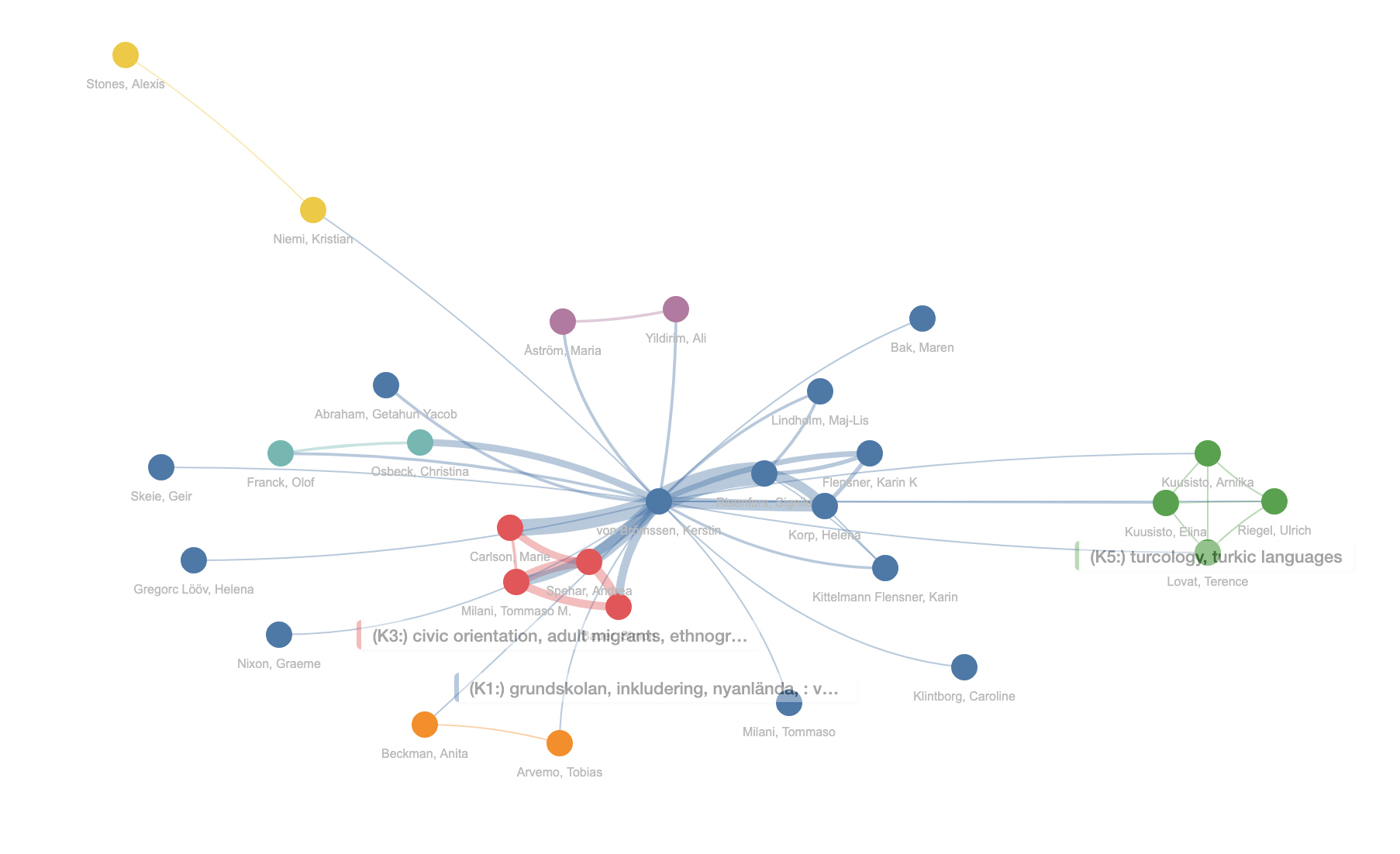
A graph representation of publication data in which nodes are authors and edges their shared publications. Bifrost visualises the networks interactively and computes network metrics such as centrality and clustering. Edges are counted using full counting: co-authorship relations are not down-weighted when a publication has many authors. See Perianes-Rodriguez et al. (2016) for a discussion of when full versus fractional counting is appropriate.
Read more: Perianes-Rodriguez, A., Waltman, L. & van Eck, N. J. (2016), Constructing bibliometric networks: A comparison between full and fractional counting, Journal of Informetrics.